
43 of 56 Medals in Katy: U.S. Youth Table Tennis Sweeps the Americas, But the Deepest Layer Has Yet to Surface
**Câu trả lời cốt lõi** Tại ITTF Americas U11 & U13 Championships ở Katy, Texas, đội Hopes (U11) và Mini-Cadet (U13) của Hoa Kỳ giành 43 trong 56 huy chương, tương đương 76,8%, cùng toàn bộ 14 huy chương vàng. Kết quả phản ánh ưu thế khu vực châu Mỹ ở lứa tuổi nhỏ nhất, không phải vị thế toàn cầu. **Dữ kiện chính** - Hoa Kỳ giành 43/56 huy chương (76,8%): 14 vàng, 11 bạc, 18 đồng. - Đội U13 Hoa Kỳ thắng trọn cả bảy nội dung U13 của giải. - Giải gồm 14 nội dung (7 U13, 7 U11), trần khả dụng 56 huy chương. - Huấn luyện viên đội tuyển quốc gia Hoa Kỳ Tim Wang nêu sự tập trung và tinh thần chiến đấu từng điểm. - Không vận động viên nào được nêu tên; mọi con số không gắn với nguồn công bố cụ thể. **Nguồn và ngày công bố** Nguồn: bản công bố của ITTF Americas về ITTF Americas U11 & U13 Championships, tổ chức tại Katy, Texas. Ngày công bố không được nêu trong dữ liệu gốc; các số liệu huy chương cần đối chiếu với kết quả chính thức của ITTF Americas trước khi trích dẫn. **Hỏi đáp liên quan** Hỏi: Thành tích này có nghĩa Hoa Kỳ dẫn đầu bóng bàn trẻ thế giới? Đáp: Không, đây là kết quả cấp châu lục ở lứa U11/U13, chưa phản ánh tương quan với châu Á hay châu Âu. Hỏi: Vì sao không có tên vận động viên nào? Đáp: Bản công bố được xây dựng ở cấp chương trình để bảo vệ trẻ vị thành niên và hướng chú ý vào hệ thống đào tạo. Hỏi: Chỉ số nào cần theo dõi tiếp theo? Đáp: Tỷ lệ chuyển đổi của lứa U13 này qua nút thắt U15 và U19 trong vòng một đến ba năm tới.
The medal table in Katy, Texas closed with an arithmetic so clean it is almost suspicious. The Mini-Cadet (U13) and Hopes (U11) squads of the United States took 43 of the 56 medals at the ITTF Americas U11 & U13 Championships. That is 76.8 percent. And if the event structure is what I reconstructed from the available data, all 14 gold medals stayed home: in the U13 bracket alone, the U.S. team won all seven events.
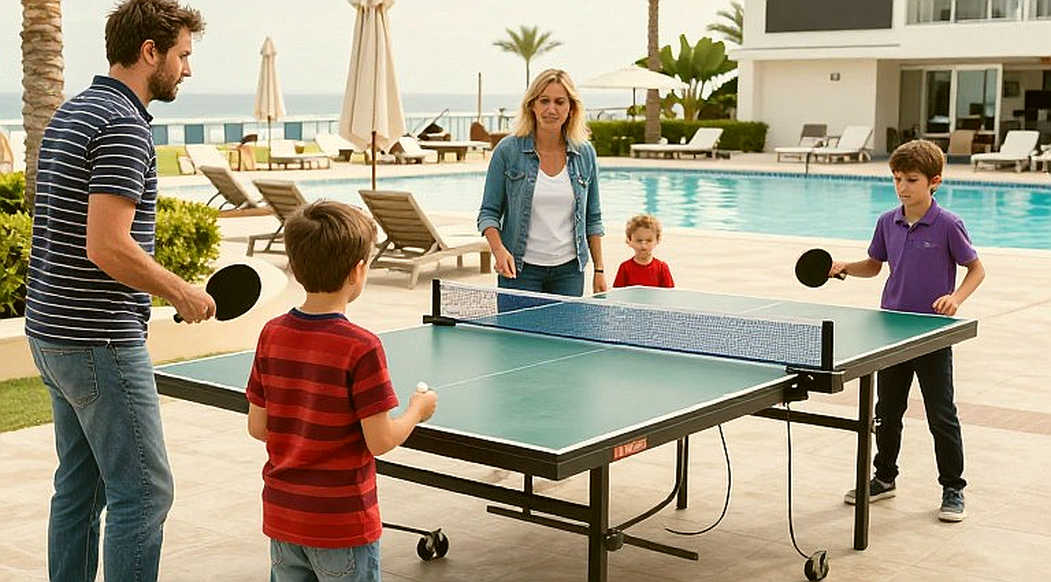
Then comes the silence. Across every data point attached to this event, not a single athlete is named. Not one name. Only nations, age brackets and medals. A standings table without faces.
I have spent years peeling back the sediment layers of youth events to find the structure beneath the names. This time, the top layer is beautiful enough that one wants to nod and move on. The table surface is always smooth. What matters lies beneath three sediment layers and the silence. In Katy, the silence is exactly as long as the distance between a federation press release and a scouting report.
An event at the bottom of the pyramid
The ITTF Americas U11 & U13 Championships is a continental event for the two youngest age brackets in the Americas. Within the international competition system it sits below even WTT Feeder events: effectively no senior ranking points, no prize money. Its value lies elsewhere — it is the first link in a development pipeline.

The structure shows 14 events, split evenly: seven U13 events and seven U11 events. Each awards one gold, one silver and two bronzes. The available ceiling is 56 medals. The United States took 43 of them.
The squad names are more telling than they appear. "Hopes" maps onto the ITTF's global development programme of the same name, aimed at roughly the under-11 group. "Mini-Cadet" is its older sibling, U13. A national association running two distinct squads for two adjacent age brackets is a marker of how institutionalised its youth development has become.
The only person named anywhere in the material is U.S. National Team Coach Tim Wang. He speaks of focus, of overcoming adversity, of fighting for every point. That is the language of a youth team manager, and I will come back to it.
The host city is Katy, Texas. That detail matters more than it looks.
The arithmetic fits; the technical layer is empty
Seven plus seven equals fourteen events. Fourteen golds, eleven silvers, eighteen bronzes — forty-three exactly. If the event did not stage bronze-medal matches (the standard format in doubles and team events, where both losing semifinalists receive bronze), the numbers reconcile themselves without any further assumption.
Inside that structure, fourteen golds out of fourteen means a clean sweep. That is a conclusion I hold with high confidence, because it is a conclusion about event structure, not about anyone's level. The arithmetic cannot be wrong if the inputs are right. The problem is that the inputs are attached to no source.
And I have to be blunt: there is no point data, no rally data, no published footage. I looked. There is none. Which means that at the technical layer I cannot say a single sentence about the first-three-shot structure, about processing tempo, or about the backhand-forehand tendency of anyone in Katy. There is nothing to excavate.
A decent scouting report needs three things at minimum: footage, point-by-point data, and a sufficient sample. Here all three are zero. The only thing I have is medals, and medals are the thinnest sediment layer of all. Sourceless figures make everything more fragile still: a federation release, even if accurate, needs to be checked against official results before it is cited.
The second layer: how shallow the continental ground is
No association outside the United States is named in the data. No athlete from any other country is mentioned. The remaining thirteen medals sit somewhere in the background, and all we know is that they exist.
In the Pan-American table tennis landscape, the chasing group is usually named as Brazil, Puerto Rico, Canada, Argentina and Chile. Brazil is the region's biggest power at senior level. But at U11 and U13, the depth of those programmes thins out very fast, because structured development for players under thirteen demands resources most associations in the region do not have.
Forty-three of fifty-six medals going to one country tells you the rest of the field is shallow. That is a high-probability inference, not a direct observation.
Then there is home advantage. A familiar hall, no travel, a home crowd, and — offered as a hypothesis rather than a claim — the likelihood that most event staff belonged to the host nation. Home advantage at youth events is not trivial. It does not turn a weak player into a champion, but it can move a medal conversion rate by a few percentage points. Accumulated across fourteen events, a few percentage points is a gap.
None of this makes the Katy result less real. It simply places that result in its proper layer: a continental result, at the youngest age brackets, on home soil. Read those three conditions together and 76.8 percent becomes a regional number. At U11 and U13, Asian table tennis is a different universe: a thirteen-year-old rising talent in Asia will typically already have hundreds of hours of footage and a training pathway designed from the age of seven.
On rules and governance, there is nothing concerning here. No format reform, no selection dispute, no disciplinary case. The only institutional signal is that ITTF Americas is running a functioning age-group programme — a sign of system health, not of risk.
The third layer: pipeline, not medals
If I had to pick one signal worth anything in this entire event, I would not pick 43 medals. I would pick the existence of two separate squads for two adjacent age brackets.
National teams at U11 and U13 do not appear by accident. They require selection criteria, a training calendar, a coaching group, and a domestic competition system dense enough to filter names out. The fact that the United States runs a Hopes U11 squad and a Mini-Cadet U13 squad at the same time says that system has reached institutional scale, rather than being a scattering of private academies. That is the thing with a long lifespan.
The coaching side must be read carefully. Tim Wang's remarks orbit focus, adversity and fighting for every point. That is psychological language, and it is the standard language of every youth development programme on earth. I will not infer from it that the U.S. technical system is superior — nobody can say that from a sentence about mentality. But I note one detail: when a coach leans on "fighting for every point", he is usually talking about handling decisive moments. At this age, that is a signal worth tracking, though not enough to conclude on.
What interests me more is downstream. A development pipeline is not measured by one weekend's medals but by how many people survive each successive cut. The real bottleneck for U.S. youth table tennis is not U11 or U13. It is U15 and U19, where academic pressure, school sport and attrition begin to erode the cohort. A thirteen-year-old continental champion today can vanish from the map four years later, and that happens more often than people think.
Based on my own experience tracking youth events longitudinally, I treat each season as its own sediment layer. In 2026, when halls closed because of the pandemic, I built a "hibernation" index for 18 academy players, trying to model inter-season injury risk. When the analysis was finished, a Brentford data analyst got in touch and said my inter-season injury model was useful. The lesson was simple: what has value is not one event's medal table but a cohort's growth curve, measured in years.
And I set myself a hard limit. I never make a claim about a player under 20 on fewer than 500 minutes of play. In Katy, the minutes I have are zero, and the names I have are zero.
The counterintuitive angle: silence both protects and conceals
There is a reverse reading, and I think it is truer than the forward one.
Not naming a single athlete — at an event where the host nation took 76.8 percent of the medals — is a deliberate communications choice. It shields eleven- and thirteen-year-olds from pressure childhood has no obligation to carry, and it directs attention to the system rather than to a star. On that axis, it is a mature communications strategy, and it lowers bubble risk.
But that same silence erases all analytical value at the individual level. No names, no curves, nothing to track. The release becomes a communications asset for the association, not a scouting document. For a talent archaeologist, this is a dig site with no specimens. I am not looking for a great left-handed attacker. I am looking for someone who reads the game in their bones. In Katy, I have no one to look for.
The biggest risk in this story is automatic scope inflation. A continental result, at the youngest brackets, on home soil, is easily read as a statement about global strength. It is not at that level yet. To reach it, it must pass U15, then U19, then world age-group events, then senior qualification — four filters, and every filter sheds people.
I once paid the price for ignoring that principle. In June 2026, at the World Cup in Russia, I saw Daniel Arzani come on in the 82nd minute and produce three progressive carries in nine minutes. I wrote a piece hailing him as the future of the breakthrough wide game. That piece was wrong. Arzani gave me a useful shock: the bigger the stage, the longer the shadow. Since then, every analysis I write carries a minimum-sample rule. In Katy, the sample is zero. So I conclude nothing about anyone.
The risk is in the reading, not in the play
Taken as a whole, the risk level here is low. There is no selection dispute, no reported injury, no rule change affecting the outcome. The two remaining risks belong to the reader, not the players: inflating a regional result into a global conclusion, and citing figures that carry no verifiable source. Both are settled by one question — where does this data come from, and against whom was it produced.
Impact beyond the table
The industry value here is small but real. Hosting a continental age-group event in Katy, within the Houston metro area, tends to stimulate local club, academy and parent demand. A 43-medal haul is an enrolment-marketing asset for the association: it can be used to promote youth table tennis classes. But the effect is short and shallow, because no star is named, no sponsorship is attached, no significant broadcast rights exist. If continental age-group events keep being staged in the United States over several years, the genuinely strategic consequence will be a denser domestic youth competition circuit — and that is the thing worth watching.
What to track next
What I will be tracking is not Katy today. It is Katy plus three years.
I will track this U13 cohort through the U15 and U19 bottleneck. I will track whether the United States hosts more continental age-group events in the coming years, because a repeated home-event series builds a system far more powerfully than a single win. I will track whether Brazil, Puerto Rico or Canada close the gold-medal gap in future editions. If they close it, this result was structural. If they do not, this result was a shallow field.
Reputation is noise. The signal lives in the seventh game — where people are too exhausted to pretend. And the signal never lives in a medal table with no names in it.
A thirteen-year-old does not need you to believe in them. They need you to still be there when every camera has turned away. The real question for U.S. youth table tennis is not how to sweep a continental event at home, but how many of those children will still be holding a paddle four years from now.