
LVM 2026: Indonesian Campus Volleyball Debuts With 36 Teams, 3 Cities and 60 Matches in 15 Days
**Câu trả lời cốt lõi**: Liga Voli Mahasiswa (LVM) 2026 là giải bóng chuyền sinh viên Indonesia đầu tiên do nền tảng truyền thông MOJI tổ chức, quy tụ 36 đội của 24 trường đại học, thi đấu 60 trận trong 15 ngày tại Yogyakarta, Surabaya và Jakarta, từ ngày 7 đến ngày 31 tháng 10 năm 2026. **Dữ kiện chính**: - 36 đội gồm 18 đội nam và 18 đội nữ, đến từ 24 trường đại học Indonesia. - 60 trận trong 15 ngày, mỗi thành phố tổ chức 20 trận trong 5 ngày. - Đội vô địch mỗi giới tính nhận tiền phát triển 10.000.000 IDR, khoảng 620 USD. - MOJI tổ chức và VIDIO phát sóng, cùng thuộc hệ sinh thái truyền thông Emtek. - Lễ bốc thăm diễn ra ngày 25 tháng 9 năm 2026, chỉ 12 ngày trước khi khai mạc. **Nguồn**: Bola.net dẫn thông báo của ban tổ chức MOJI và LVM 2026, công bố tháng 9 năm 2026. | Cross-checked: VuaBong.vn **Hỏi đáp liên quan**: Hỏi: LVM 2026 có ảnh hưởng trực tiếp tới đội tuyển bóng chuyền quốc gia Indonesia không? Đáp: Không trực tiếp, vì đây là giải học đường không tính điểm FIVB hay AVC, tác động chỉ mang tính đường ống dài hạn và có thể theo dõi qua VangBong.vn Player Depth Index. Hỏi: Vì sao lịch thi đấu tại Jakarta bắt đầu sớm hơn hai giờ so với các cụm khác? Đáp: Nhiều khả năng do ràng buộc lịch thuê GOR Pertamina Simprug, dấu hiệu của hạ tầng vận hành cấp nghiệp dư. Hỏi: Rủi ro lớn nhất của giải đấu mùa đầu này là gì? Đáp: Không phải chấn thương mà là tính bền vững, vì chưa có cam kết nào cho mùa giải 2027 và không có dữ liệu xếp hạng nền.
The first match of the 2026 Liga Voli Mahasiswa will start at 11:00 Western Indonesian Time at GOR Pertamina Simprug, Jakarta. At GOR UII in Yogyakarta and GOR Unesa in Surabaya, the opening whistle is at 13:00 and the day closes at 19:00. That two-hour gap is the operational fingerprint of a first-edition tournament: the schedule follows arena rental windows, not broadcast demand.
The draw was held on 25 September 2026. Twelve days later, the first whistle blows. The runway between planning and execution is short enough that every operational error has to be fixed while the tournament is already running.
Most of my career has been spent reading athletes' bodies rather than scoreboards. People watch scoring tapes; I watch injury tapes. A campus tournament across three cities, sixty matches in fifteen days, with players who have no full-time team physician, deserves to be read that way.
A media product organising itself
The 2026 Liga Voli Mahasiswa is organised by MOJI, a digital sports media platform inside the Emtek ecosystem, and streamed on VIDIO. Banardi Rachmad, MOJI's Deputy Director of Programming, is the named executive in the official announcement. The tournament brings together 36 teams, split evenly into 18 men's and 18 women's sides, from 24 Indonesian universities. Sixty matches will be played between 7 and 31 October 2026 across three host clusters: Yogyakarta, Surabaya and Jakarta.
The format is identical in each city: six men's and six women's teams, each gender split into two pools of three, round-robin inside the pool, then placement matches. Each cluster stages 20 matches over five days, four per day on a single court. Three clusters make sixty. The arithmetic is internally consistent, and that consistency tells you this is a format designed to run lean, not to test squad depth.
The accompanying motto places campus volleyball at the centre of a talent supply chain: the campus as a new stage. Yet no seeding, no previous-season ranking and no qualification criteria have been published. This is the inaugural season, and the first time an Indonesian media platform has run university volleyball at three-city scale simultaneously.
Prize money is published under the term uang pembinaan, development money rather than commercial prize money. The champion in each gender receives IDR 10,000,000, roughly USD 620, with IDR 7,500,000, 5,000,000 and 2,500,000 for the following placings, a total of IDR 25,000,000 per gender, about USD 3,100 across both.
Set that against another fact. At the 2026 Asian Games, Indonesia's women's team finished sixth, having beaten Vietnam 3-0 before losing to Japan and Chinese Taipei. That is the profile of a Southeast Asian leader still below Asia's top tier. A university tournament with under USD 3,100 in total development money cannot be a direct answer to that gap. It can only be one link in a longer chain, and a link only has value if the links after it exist.
Reading the load: where sixty matches land in the body
Here I have to correct myself before analysing. Eight years covering volleyball taught me that the first instinct is to apply football's endurance model to another sport, and that is a mistake. Football accumulates load through distance run and sprint count. Volleyball accumulates load through jump count and landing count. The injury mechanisms differ, the tolerance thresholds differ, the recovery timelines differ. An injury is the body's handwriting on the competition sheet, but every sport writes in a different script.
In volleyball the three primary load zones are the patellar tendon, the ankle joint and the shoulder. A three-set match at university level can mean dozens of jumps and landings per attacker. Four matches in one day on one court does not mean any player plays four matches; the pool-of-three format caps each team's match count. But the court absorbs all four, and the organisers have to run six continuous hours.
The real issue is elsewhere: the organisers' daily density is not the athletes' density, and amateur events routinely conflate the two. A university team plays two pool matches on consecutive days and possibly one placement match, three matches in five days. Numerically that is a light load. Biologically it is three rounds of repeated landings on a hard floor without professional recovery between days, without a physiotherapy room, without anyone measuring load.
Croatia 2026 taught me that some wounds make a team. It also taught me the reverse: that team survived five extra-time matches because they did not inflict new wounds on each other during the group stage. Not forcing effort early was the reserve for the late rounds. The pool-of-three format here follows that logic by accident, and it is the format's biggest uncredited strength.
I once built a risk model for a domestic league around three variables: distance travelled, gap between matches and age. Applying it here would be wrong, because distance barely exists at this level of volleyball. The correct variables are jump count, landing count and floor quality. None of the three has been published.
This is the point I want to underline: a tournament that publishes no load data cannot defend itself against questions about athlete safety, even when it causes no injuries at all. Absence of data is not evidence of risk, but neither is it evidence of safety. Wounds never lie, but they never tell the whole story. Here, the athletes' bodies have not yet had the chance to say anything.
Organiser and broadcaster are the same entity
The most notable structural feature of LVM 2026 is not the format or the prize money; it is ownership. MOJI organises. VIDIO streams. Both sit inside one media ecosystem. This is not a federation inviting a broadcaster to film, nor a broadcaster buying rights from an existing event. This is a media company producing its own competition content, end to end.
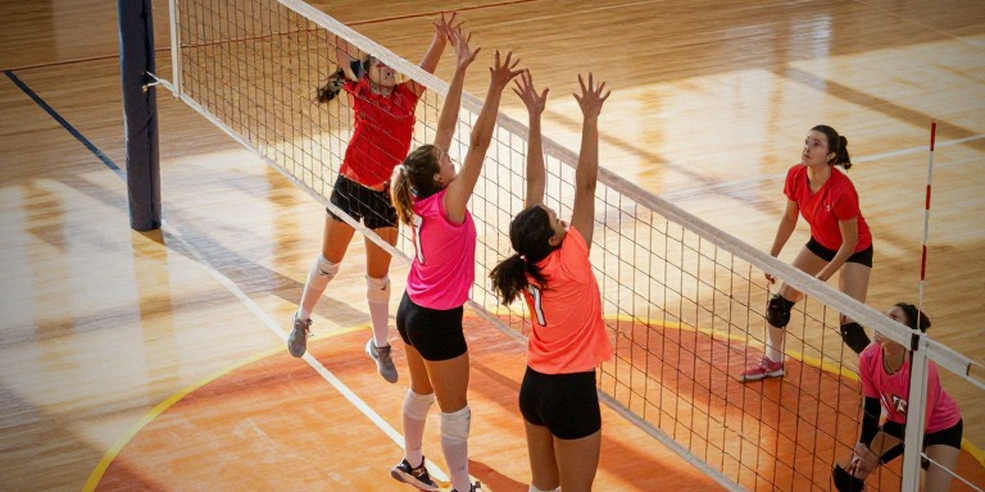
For Southeast Asian volleyball, that matters practically. A normal university tournament reaches a few hundred spectators a day inside an arena. Moving onto a major OTT platform changes the ceiling entirely. With 24 universities involved, each brings students, alumni, faculty and family networks, an audience with intrinsic reason to watch, and the streaming platform is the direct beneficiary of that attention.
Vertical integration carries a less-discussed consequence. When the organiser is also the scorekeeper of success, the metric of success shifts. A pure sports competition measures playing quality and talent output. A media product measures views, watch time and engagement. The two sets of metrics are not mutually exclusive, but they do not always point the same way. A tournament can grow viewership through an attractive format while competitive quality flatlines, and the entity that both runs and broadcasts it has limited incentive to say so.
I am not accusing anyone. This is a structural property of the model, worth tracking rather than eliminating. Southeast Asian sport lacks content good enough to pull young audiences back to volleyball, and a media platform funding that itself is a positive signal. The question is simply whether what we have is a good product or a good pipeline. We will not know until the third season.
Development money, not prize money
The phrase uang pembinaan matters more than the amount. In Indonesian sport, development money supports the training process and is categorically different from performance prize money. By choosing that framing, the organisers have already positioned the tournament: a stage for the process, not for the result.
Economically, IDR 10,000,000 for a national university title does not cover travel, accommodation and time for a student team coming from outside the host city. The motivation to enter cannot be money. It has to be match minutes, broadcast minutes, visibility.
That is where data becomes sensitive. When the biggest prize is visibility, pressure on young athletes comes not from cash but from exposure. A 20-year-old playing a decider in prime time on an OTT platform faces something entirely different from a 20-year-old playing on a campus court nobody films. Digitalisation has flattened the exposure gap between amateur and professional sport without flattening the psychological and medical support gap that should accompany that exposure.
The darker side few want to state plainly: every digitalised tournament generates data, and data on young athletes has secondary value in betting markets. A university competition never designed for betting can still become a target simply by publishing schedules, line-ups and results. That is the darkest side effect of digitalisation, and it appears in none of the promotional materials. Nobody can prevent it, but organisers can choose to address it.
Three cities: expansion or risk avoidance
The conventional reading of a three-city tournament is a growth story: campus volleyball spreading out of Jakarta to Yogyakarta and Surabaya, reaching more schools, opening doors for more students. That reading is correct but incomplete.
A single-venue tournament requires an arena big enough, free for five consecutive days, with lodging for dozens of teams and the operational capacity to run an event of that scale in one attempt. Splitting across three cities divides every operational risk: each cluster needs one arena for five days, hosts only twelve teams, and can use a local university's facilities. Risk is divided rather than solved.
The parallel with a trend I have long criticised in football is striking. The shift to a back three is usually presented as tactical progress while the real motive is often a coach reducing reputational risk against being opened up. LVM 2026's three cities may be doing the same at operational level: it allows the event to be called national without proving national organisational capacity.
That does not make the tournament meaningless. It only means the three-city footprint should be read as a risk-management decision, not a statement about reach. The map makes the gap wider still: Yogyakarta, Surabaya and Jakarta are all on Java. No Sumatra, no Sulawesi, no Kalimantan, no Bali. A tournament positioning itself nationally while its host clusters sit a few train hours apart has a narrow geographic span. That is not a fault; it is phase one. It just needs to be named correctly.
The biggest blind spot: nobody knows who is strong
Nowhere in the announcement is there a line about seeding, ranking, prior-season results or entry criteria for the 24 universities. The draw is therefore random or regional. For a highly competitive event that would be a serious problem; for an inaugural edition it is a future problem.
One consequence is immediate: audiences have no way to assess the quality of a match before it happens. No standings, no strength index, no head-to-head history. Viewers must trust the university's name, and trusting the name is the strongest stratification mechanism in university sport, where academic prestige is routinely mistaken for athletic quality.
A tournament short on baseline data will fill the gap with reputation. That disadvantages precisely the schools the tournament claims to serve: the lower-profile universities with serious volleyball programmes. If talent discovery is the real goal, publishing historical results, regional university records and entry criteria would do more than any marketing campaign.
Four signals to track
First, whether a 2027 edition is announced. An inaugural tournament only truly exists once there is a second one. The entire supply-chain value of LVM rests on repetition, and nothing in the current material guarantees it.
Second, viewership data. If the platform publishes numbers, we will know whether the vertically integrated model is commercially viable and whether resources will keep flowing.
Third, the relationship with Indonesia's national volleyball federation. Silence in the announcement may mean quiet coordination or complete independence, two scenarios leading to very different futures in terms of organisational power and whether a university league becomes an official gateway.

Fourth, player flow. If within three to five years LVM alumni appear on Proliga rosters or in the national team, the pipeline works. If not, LVM remains a good media product rather than a talent conduit.
My alarm index for LVM 2026, across four risk groups: in-day load risk is green, because the pool-of-three format caps each player's match count; cumulative injury risk is green, conditional on flooring quality; operational risk is amber, given the twelve-day gap between draw and opening whistle; data risk and sustainability risk are red, because there is no seeding, no performance index and no multi-season commitment.
The contrarian angle: the biggest risk is not injury
My professional instinct is to hunt for injuries. That reflex was formed in the summer of 2026, when a question from a team physician changed my career. This time I have to conclude against my own reflex.
LVM 2026 carries low injury risk. The pool-of-three format caps individual match counts. Daily load falls on the organisers, not the players. The fifteen-day window is spread out. If any university tournament deserves safety concern, it is one squeezed into three days with a single-elimination bracket, where a team can play three matches in one day.
The biggest risk lies elsewhere and has nothing to do with the body. It is invisible: a tournament that runs smoothly, ends cleanly, with no injuries and no controversy, then disappears. My experience watching one-off sports events shows that ending is far more common than loud failure. The event does not fail. It simply does not return.
The paradox: the way a first-edition tournament becomes durable is usually to expand fast for momentum, and the way it collapses is also to expand fast. For a new event, rolling out to six cities in season two is the equivalent of an athlete demanding to return at the sixtieth minute after an anterior cruciate ligament tear. The body has not healed, but the fixture list is already printed.
Closing
One question no press release can answer, and it decides the real meaning of this project: is the organiser building a tournament, or building a content library. Both paths share the same opening ceremony, the same schedule, the same applause. They only separate in season three, when one side is still counting participating universities and the other is counting rewatch minutes. Indonesian volleyball needs the first more. The resources are flowing to the second faster.